
What is Web 3.0?
The next version of the World Wide Web, known as Web 3.0, is focused on creating a more intelligent and user-friendly web that can comprehend and process information more than a human does. The utilisation of artificial intelligence, natural language processing, machine learning, and the integration of the Internet of Things are some of the fundamental components of Web 3.0. (IoT). It is relatively early in the development of Web 3.0; therefore, it is unclear what exact technologies and applications will be included. However, it is anticipated to significantly alter how individuals use the internet and engage with online information.
Building blocks of Web 3.0
A variety of technologies are anticipated to be fundamental components of Web 3.0. The following are some of the important technologies that are anticipated to contribute to the development of Web 3.0:
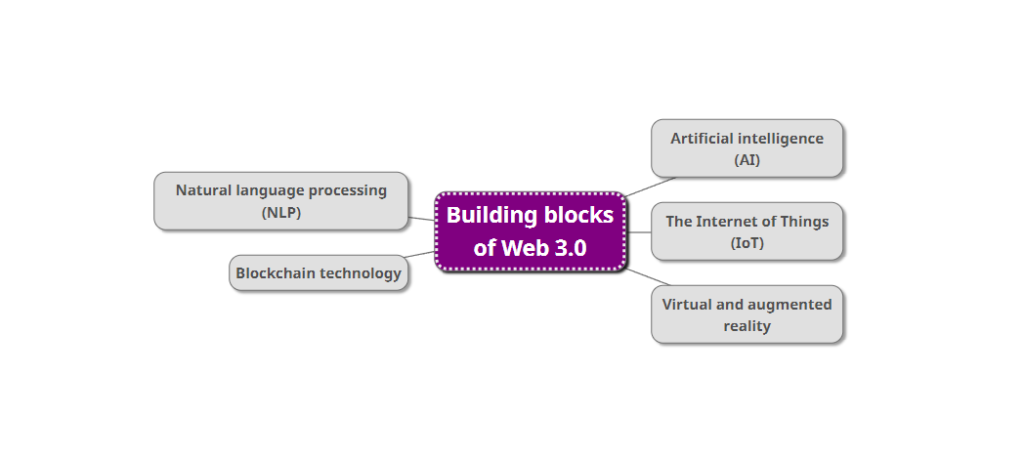
- Artificial intelligence (AI): AI is anticipated to be used in Web 3.0 to provide more intelligent and user-friendly online experiences. This might involve using machine learning techniques to make the web more able to comprehend and process information.
- Natural language processing (NLP): In order to enable more natural and seamless communication between humans and robots, Web 3.0 is anticipated to leverage NLP. This might involve creating chatbots and other conversational interfaces that can recognise and respond to human speech.
- The Internet of Things (IoT): NLP is anticipated to be used in Web 3.0 to provide more natural and seamless communication between robots and people. The creation of chatbots and other conversational interfaces that can comprehend and respond to human language falls under this category.
- Blockchain technology: Web 3.0 is expected to make use of blockchain technology in order to enable more secure and decentralised online applications and services. This could include the use of blockchain-based platforms for everything from online payments to data storage.
- Virtual and augmented reality: Virtual and augmented reality technologies are anticipated to be used by Web 3.0 to allow more immersive online experiences. This can entail the creation of fresh software and services that benefit from VR and AR advancements.
changes it will bring to the world
It is anticipated that Web 3.0 would significantly alter how people access the internet and engage with online information. For instance, it might make it possible to develop brand-new, presently impractical products and services, as well as more tailored and pertinent online experiences. On fields like healthcare, economics, and education, as well as on society at large, Web 3.0 may have a profound effect.
It is crucial to keep in mind that Web 3.0 is still in its early stages of development and that its exact technologies and applications are not yet known. As a result, it is challenging to foresee with precision how Web 3.0 will change the world.